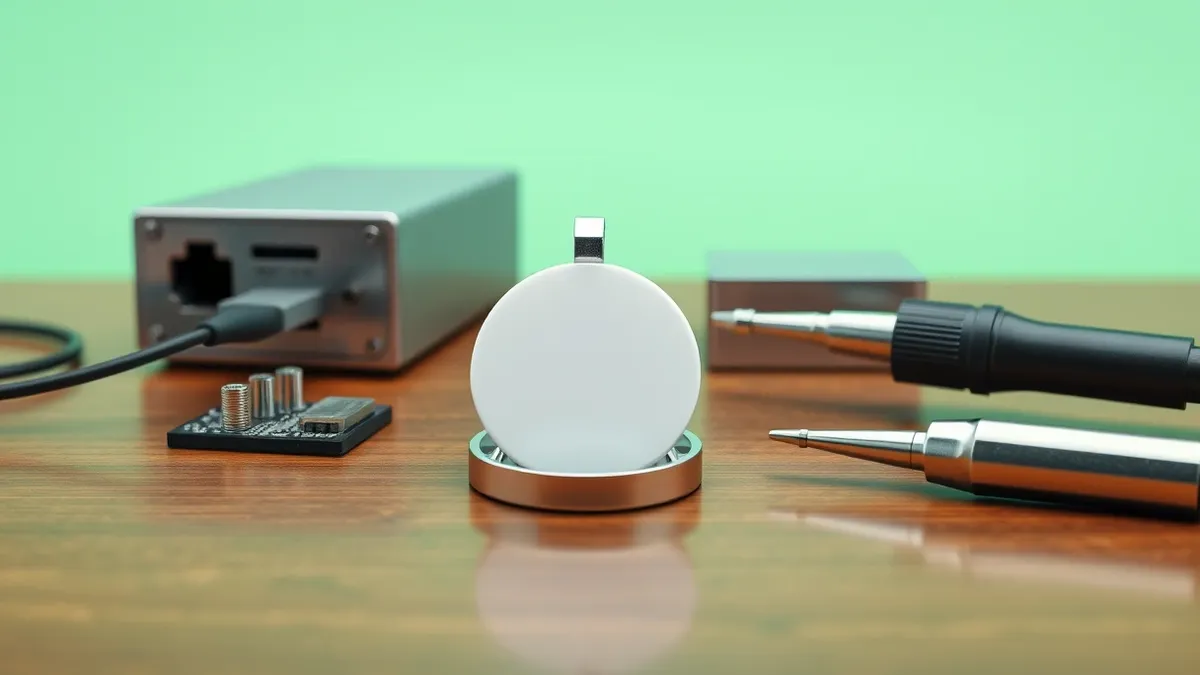
A developer reported to The Verge that they built a working AI companion device for $50 using Meta’s open-source code, predating the retail release of the commercial Muse Charm.reported This DIY version uses a Waveshare ESP32-S3 1.75C touchscreen pendant sourced from China. The device connects to Meta’s Muse AI cloud using official tokens and open-source code provided by the company.
What changed
The developer paid $50 for the Waveshare ESP32-S3 1.75C, a 1.75-inch touchscreen computer pendant. Meta officially lists this hardware as one of its first suggestions for building a “Muse Gadget.” The device serves as a drop-ship alternative to the upcoming holiday retail Muse Charm. It lacks cameras and 5G cellular radios found in higher-end concepts but interfaces directly with Meta’s AI infrastructure.reported
How it works
The user plugged the pendant into a PC and used Claude to point at Meta’s GitHub repository. After pairing the device with the Muse phone app and inserting Meta’s API keys, the system began communicating. The developer used Claude Code to reprogram the device, fixing issues where the AI initially misinterpreted audio inputs as transcription requests rather than voice commands. This process enabled the device to interact with the Muse cloud.
What the evidence means
The initial out-of-the-box experience was poor, with slow responses and no audio output for Muse’s replies. The on-screen display showed only fragments of text, requiring the user to check their phone for full messages. Meta’s build included only a static Jolly avatar and failed to automatically discover smart home devices like Amazon Echo or Google Home units, rendering the gadget largely non-functional upon first installation.
The evidence for skeptic
The Verge reports that significant manual intervention was required to make the device useful.reported The developer stated that sessions of Claude Code were necessary to fill functional holes, such as enabling remote camera viewfinder capabilities and smart home control. The source acknowledges that the device “theoretically” controls smart home systems but required “extra vibe code” to function. The lack of a remote shutter button and automatic device discovery in Meta’s sample app suggests the official SDK is incomplete for consumer-ready hardware without substantial developer effort.
Why it matters
- Meta’s open-source Muse Gadget SDK requires significant developer effort to achieve basic voice command functionality, as noted in the Verge report.
- Official hardware recommendations like the Waveshare ESP32-S3 do not include cameras or cellular connectivity, limiting standalone use cases.
- The initial failure to distinguish between audio transcription and voice commands indicates potential friction in Meta’s cloud integration for third-party devices.
- Developers must manually reprogram devices using tools like Claude Code to enable features like smart home discovery and remote camera controls.
Topics: Meta, Muse AI, open-source, hardware development, ESP32
Updated
Ask the article
Local keyword search of this article; no generated answers.Did this article give you the evidence you needed?
Your choice stays on this device. No public tally.Questions readers ask
How much does the DIY Muse gadget cost?
The developer paid $50 for the Waveshare ESP32-S3 1.75C pendant.
Does the device work out of the box?
No, the Verge report states it felt useless initially and required reprogramming with Claude Code.
Is the hardware officially sanctioned by Meta?
Yes, Meta lists the Waveshare device as a suggestion for building a Muse Gadget.
Connected stories
Reading receipt
- The custom device costs $50 compared to the higher-priced Muse Charm.
- Meta officially sanctions the Waveshare ESP32-S3 as a Muse Gadget base.
- Initial setup required significant reprogramming to achieve basic functionality.